
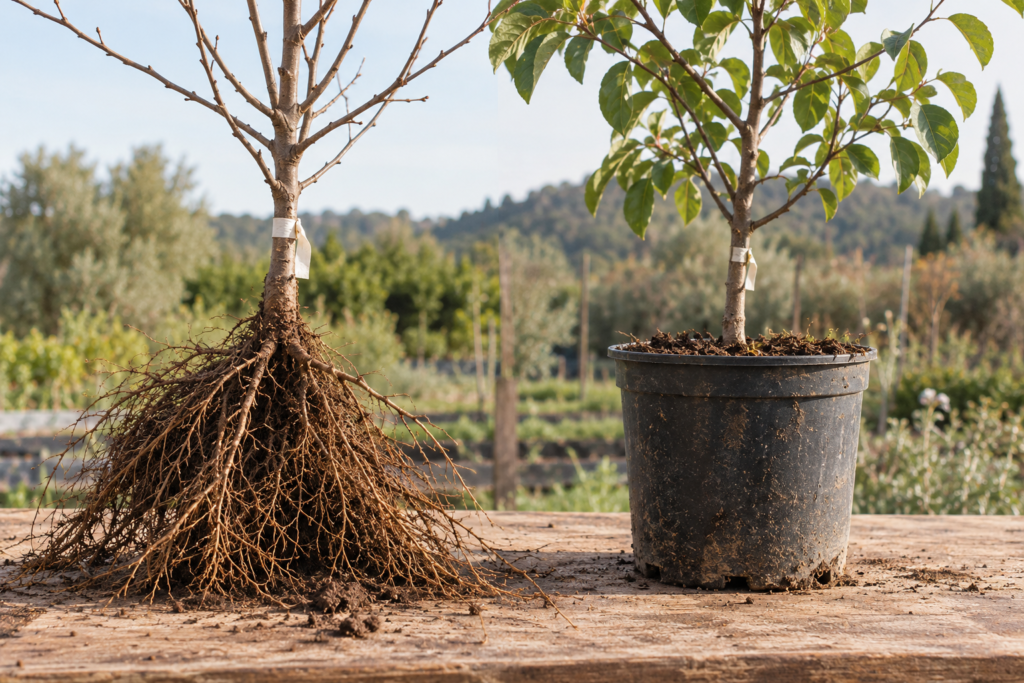
We are used to seeing potted fruit trees available very early in the season. As soon as the first autumn rains arrive, often from October onwards, they can already be planted. But as winter approaches, another option becomes available: bare-root fruit trees.
Although less familiar to many gardeners, they have one important advantage: their root system.
Roots that develop naturally in the ground
Bare-root trees are grown directly in nursery soil. Their roots can therefore develop and branch naturally, without being restricted by the walls of a container.
A tree that remains in a pot for too long, on the other hand, can develop roots that circle around the inside of the container, eventually becoming root-bound. If these deformations become significant, they can persist after planting, restrict outward root growth and, over time, affect the tree’s establishment and development.
With a bare-root tree, the root system is visible at planting time. Its structure can be examined and the roots can be spread naturally throughout the planting hole. They are immediately in contact with the soil and can continue growing outwards, without a root ball or the shape of a container restricting their development.
This is one of the major advantages of bare-root trees: from the moment of planting, the tree starts with a root architecture naturally oriented towards the surrounding soil, reducing the risk of development problems associated with roots deformed by a container.
Roots already accustomed to growing in soil
There is also a less visible difference. A tree grown in the ground develops its roots in direct contact with mineral particles, organic matter, water, nutrients and all the life present in the soil.
This includes mycorrhizal fungi, which can form symbiotic relationships with roots. Their network of filaments helps the plant explore a much larger volume of soil and can improve access to certain nutrients — particularly phosphorus — and, under certain conditions, to water.
Transplanting naturally disrupts some of these associations, but the tree has already developed its roots in real soil, and new associations can become established in its new environment.
Mycorrhizal fungi can also be present in potted trees, depending on the growing medium and cultivation methods. Horticultural substrates also have different properties from garden soil, including water retention, aeration, nutrient availability, pH and biological activity. After planting, the roots therefore have to gradually transition from this growing medium into the surrounding soil.
With bare-root trees, there is no interface between a root ball of growing medium and the garden soil: the roots are planted directly into the soil in which they will continue to grow.
What about potted trees?
Potted trees nevertheless offer some very practical advantages. They are available earlier and over a longer period. When planted as soon as the rains return in October, they have several months to begin establishing their roots before growth resumes in spring.
The pot also provides greater protection for the roots during cultivation and storage, particularly against certain pests such as rodents.
At Viveiro XXX, we take care to ensure that our potted trees have the healthiest possible root systems. This is one of the reasons why we choose to sell our potted trees young, before spending too long in a container increases the risk of becoming root-bound. A young tree also adapts more easily to its new environment, helping to reduce transplant shock.
Why try bare-root trees?
Their planting period is shorter: you have to wait until the tree is dormant, and the roots must be kept moist until planting. But when the season allows, bare-root trees offer several interesting characteristics: a root system developed in the ground, a root structure that can actually be inspected, roots that can be correctly spread out at planting, and immediate contact with the living soil of the garden.
If you have always bought your fruit trees in pots, bare-root season is an opportunity to discover another way of planting — starting, quite literally, with the part of the tree we usually cannot see: the roots.